Most UK organisations trialling automation have already met a traditional chatbot: the scripted assistant on a website that answers the same ten questions and hands off to a human the moment things get complicated. It is useful, predictable and cheap. So when someone starts talking about “AI agents“, it is fair to ask whether this is a genuine step forward or just a rebrand.
The honest answer is that they solve different problems. A chatbot follows rules; an AI agent pursues a goal. Understanding that distinction is the fastest way for a legal, accountancy, logistics or property team to work out which one actually earns its place in the business.
What a traditional chatbot actually does
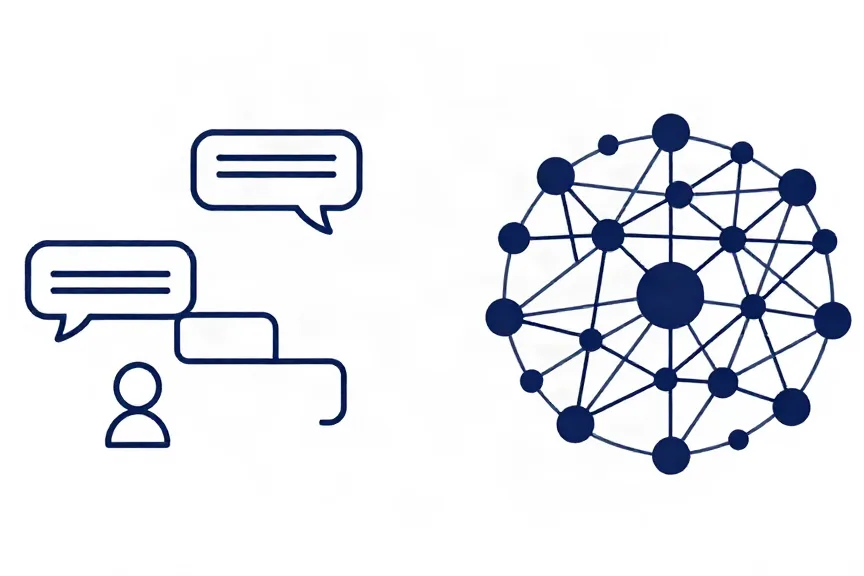
A rule-based chatbot, sometimes called a decision-tree bot, maps a narrow set of inputs to a narrow set of outputs. If a customer types “where is my order”, it replies with a tracking link. If they type something the developer did not anticipate, it apologises and escalates.
This is not a weakness so much as a design choice. Traditional chatbots are excellent at:
- Answering high-volume, repetitive questions with a consistent answer
- Capturing information through structured forms and flows
- Routing enquiries to the right human or department
- Operating within tight, well-understood boundaries
They are fast to deploy, inexpensive to run, and their behaviour is easy to predict and audit. For a business that simply needs to deflect routine website enquiries, a well-built chatbot is often the sensible, cost-effective choice.
What an AI Optimisation Assistant does differently
An AI agent is built to complete a task or a multi-step workflow, not to recite a script. It can interpret messy, natural-language requests, decide what information it needs, use tools such as your CRM, calendar or case management system, and take actions across several steps before reporting back.
In practice, that means an agent can:
- Understand an enquiry that does not match any predefined phrase
- Ask clarifying questions until it has what it needs
- Pull data from multiple internal systems to answer in one go
- Execute a workflow end to end, such as drafting a document, scheduling a follow-up or updating a record
- Handle voice conversations that flow naturally rather than forcing callers through a menu
The difference is judgment. A chatbot recognises keywords; an agent works out what the person is trying to achieve and does something about it.
Where each one wins
The clearest way to decide is to match the tool to the job.
Choose a traditional chatbot when:
- The questions are predictable and few
- The cost of a wrong answer is low
- You mainly need deflection, information capture or triage
- Speed and budget matter more than flexibility
- Your processes are simple and unlikely to change soon
Choose an AI Optimisation Assistant when:
- Requests are varied, lengthy or conversational
- Answering properly means consulting several systems
- The task spans multiple steps or needs a follow-up action
- You handle calls as well as written enquiries
- The work is currently eating skilled people’s time
A useful rule of thumb: if a new team member could handle the request with a checklist, a chatbot may suffice. If it takes judgment, context and access to systems, it is agent territory.
The cost and effort question
It is tempting to assume the agent is always the expensive option. In practice, the maths is less about build cost and more about value recovered.
A chatbot is cheap to build but limited in what it can remove from a team’s workload. An AI agent costs more up front, yet it can absorb entire workflows: qualifying leads, drafting correspondence, chasing missing information, booking appointments and keeping records current. For growing and established organisations, the return comes from hours returned to fee-earning or higher-value work, not from the licence fee alone.
The right question is not “which is cheaper”, but “how much repetitive admin does each one remove, and what is that worth to us?”
Can you start with one and grow into the other?
Yes, and for many UK teams this is the most pragmatic route. A common pattern is to launch a simple chatbot to handle the highest-volume enquiries, learn what people actually ask, then evolve into an AI agent as the requirements become clearer.
What matters at that point is architecture. An agent development partner builds on modular foundations – clean integrations, clear data boundaries and a defined escalation path to a human – so that today’s chatbot can grow into tomorrow’s workflow engine without starting again. That approach also keeps data security, compliance and oversight front of mind, which is essential for professional services.
A quick way to self-qualify
Before speaking to anyone, businesses can compress the decision into four questions:
- Are the requests predictable and narrow, or varied and conversational?
- Can one system answer them, or is data spread across several?
- Does resolving the request need a follow-up action, not just a reply?
- What is the cost of a routine enquiry sitting in a queue for a day?
If the answers lean simple and static, a traditional chatbot is likely the right and affordable choice. If they lean varied, multi-step and system-dependent, an AI Optimisation Assistant will pay for itself far sooner than a chatbot ever could.
The bottom line
AI agents and traditional chatbots are not rivals so much as different tools for different jobs. Chatbots are the dependable, low-cost option for answering predictable questions and deflecting routine traffic. AI agents are the choice when the work demands judgment, context and the ability to act across systems.
For most growing UK organisations, the practical path is to start where the pain is sharpest, prove the value, and scale from there. If you are weighing up whether your workflows need a simple bot or a proper AI agent, that decision – made deliberately rather than by default – is the one that determines whether automation genuinely reduces admin and improves client experience, or just adds another layer to manage.