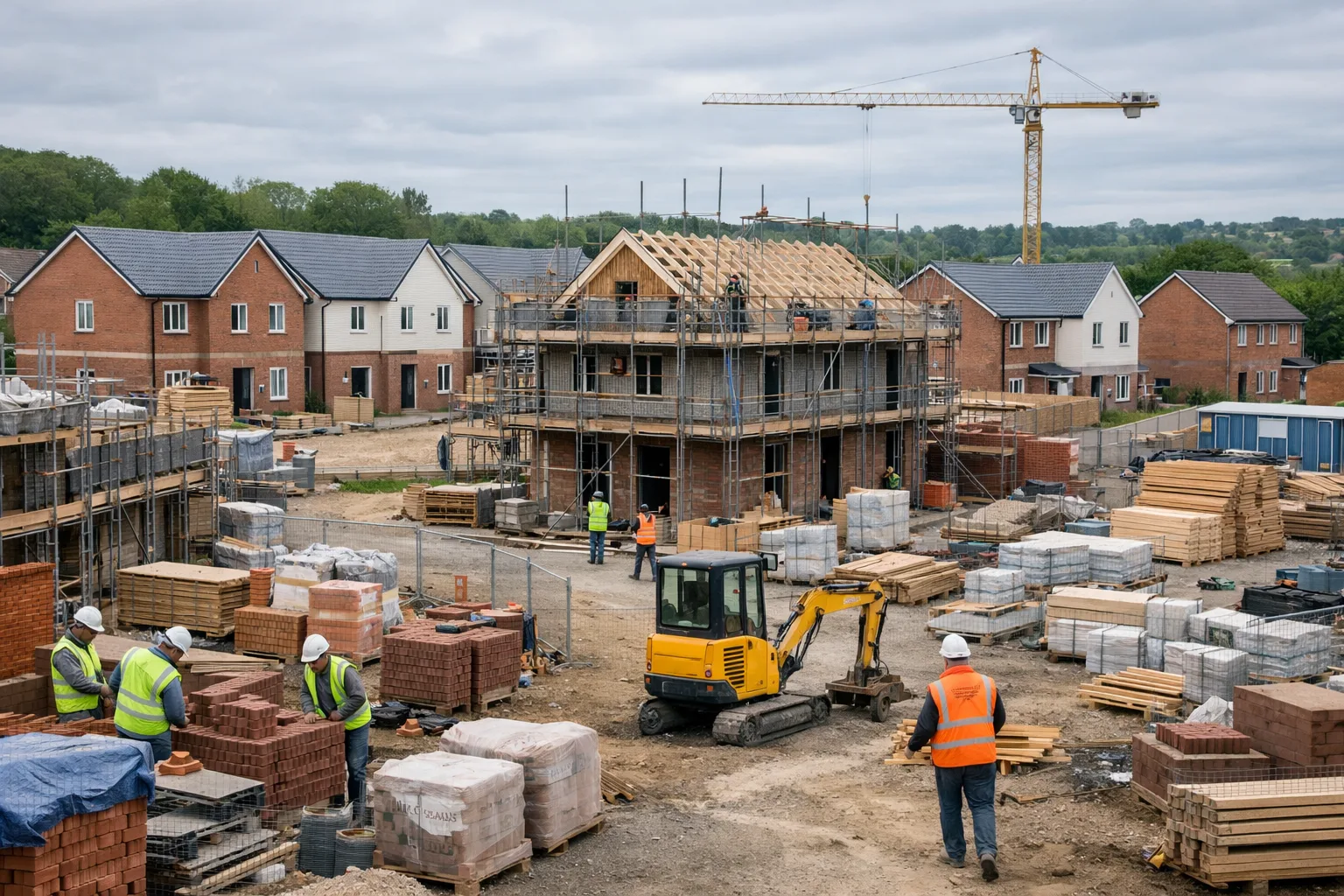
Construction in the UK is under more pressure than ever. Rising construction costs, tightening regulations, labour shortages, and increasingly ambitious sustainability targets have created a delivery environment where every project feels like a race against time. Yet the industry’s biggest challenge isn’t speed — it’s predictability.
Developers aren’t just trying to build faster; they’re trying to build smarter, with fewer surprises, fewer redesigns, and fewer compliance headaches. And this is exactly where AI is beginning to reshape the design‑to‑delivery pipeline.
Over the past two years, AI has moved from experimental pilot to operational reality across the built environment. Generative design tools, simulation engines, and predictive analytics are now being deployed on major UK schemes, helping developers compress design cycles, reduce rework, and maintain quality even as timelines tighten. The shift is subtle but profound: AI isn’t replacing architects, engineers, or project managers — it’s augmenting them, giving teams the ability to test, validate, and optimise decisions long before they reach the site.
What’s driving this acceleration? Partly necessity. The UK’s regulatory landscape is evolving quickly, especially with the Building Safety Act and the emerging AI governance frameworks. Developers must now maintain clearer digital records, demonstrate compliance earlier, and coordinate more tightly with contractors and consultants. AI helps automate these obligations, reducing administrative drag and freeing teams to focus on design intent and delivery strategy. But the bigger driver is opportunity. AI gives construction firms something they’ve never truly had: real‑time intelligence across the entire project lifecycle.
Generative design is one of the clearest examples. Tools such as Autodesk’s generative design engine can evaluate thousands of design permutations in minutes, optimising layouts for cost, structural efficiency, daylighting, sustainability, and regulatory constraints. According to industry analysis, generative design can reduce material use by up to 30% and accelerate design cycles by up to 50% . For developers, this means faster feasibility studies, more accurate early‑stage modelling, and fewer late‑stage design changes — one of the biggest causes of project delays.
Simulation tools are delivering similar gains. AI‑enhanced structural analysis, environmental modelling, and energy‑use simulations allow teams to validate design decisions earlier and more reliably. Instead of waiting for specialist consultants to run isolated models, developers can use AI‑powered platforms to test multiple scenarios instantly. This doesn’t replace expert judgement — it amplifies it. Engineers can spend less time processing data and more time interpreting insights, improving both speed and quality.
Compliance is another area where AI is quietly transforming workflows. The Building Safety Act requires a “Golden Thread” of information throughout a building’s lifecycle. AI systems are now being used to extract structured data from drawings, specifications, and BIM models, ensuring that safety‑critical information is captured accurately and consistently. Regulatory bodies are also exploring AI to speed up planning assessments and reduce administrative bottlenecks, with government pilots testing AI‑enabled planning automation to accelerate consenting processes . For developers, this means fewer delays at gateway stages and clearer visibility of compliance risks.
But perhaps the most compelling impact of AI is in coordination — historically one of the biggest pain points in construction. With multiple consultants, contractors, and suppliers working across different systems, information often becomes fragmented. AI‑driven BIM integration helps unify these data streams, enabling real‑time clash detection, automated document control, and predictive scheduling. When AI identifies a potential conflict between structural and MEP layouts, or flags a procurement delay that will impact sequencing, teams can intervene early rather than firefighting later. This shift from reactive to proactive management is one of the most important steps toward reducing overruns.
Quality, however, remains the non‑negotiable. Developers cannot afford to accelerate delivery at the expense of design integrity or compliance. The good news is that AI doesn’t compromise quality — it protects it. Computer vision systems can monitor site progress and safety in real time, comparing actual conditions against BIM models and highlighting deviations instantly. AI‑powered safety systems have already delivered measurable improvements, with firms such as Multiplex reporting a 31% reduction in reportable incidents after deploying AI‑driven monitoring tools . When quality issues are caught early, they’re cheaper and faster to fix.
There are challenges, of course. Adoption remains uneven across the sector. Only 36% of firms report having clear AI strategies, and many cite legacy systems, unclear use cases, and skills shortages as barriers to adoption . Cultural resistance also plays a role — some teams remain wary of automation or sceptical of AI‑generated recommendations. And the regulatory landscape is evolving quickly. The EU AI Act will classify certain construction‑related AI tools as “high‑risk,” requiring stricter oversight and documentation, while the UK is pursuing a principles‑based approach through existing regulators Browne Jacobson LLPBrowne Jacobson LLP. AI in construction 2026: Legal risks & regulatory compliance. Developers must navigate these frameworks carefully, ensuring that AI systems are transparent, auditable, and responsibly deployed.
Liability is another emerging concern. When an AI system contributes to a design decision, who is responsible if something goes wrong? Contracts have not yet caught up with AI adoption, and bespoke provisions are increasingly required to clarify ownership, oversight, and accountability. Intellectual property questions are also becoming more complex, especially as AI tools generate design outputs that blend human and machine input. These issues won’t stop AI adoption, but they will shape how developers integrate AI into their workflows.
Despite these challenges, the direction of travel is clear. AI is becoming a foundational capability in construction — not a bolt‑on tool, but a core part of how projects are conceived, validated, and delivered. The developers who embrace AI early will gain a competitive advantage: faster design cycles, fewer overruns, stronger compliance, and higher‑quality outcomes. Those who delay risk falling behind as clients, regulators, and contractors increasingly expect AI‑enabled workflows.
The future of construction won’t be defined by how quickly we can build, but by how intelligently we can deliver. AI gives the sector the ability to move at speed without sacrificing quality — to compress timelines while strengthening compliance — to innovate without increasing risk. It’s not about replacing human expertise; it’s about giving that expertise the tools it needs to thrive in a more complex, more regulated, and more demanding environment.
The next decade of UK construction will be shaped by those who recognise that AI isn’t just a technological upgrade — it’s a strategic shift. The firms that succeed will be the ones that build smarter, not just faster.
References
- Browne Jacobson LLP, AI in Construction 2026: Legal Risks & Regulatory Compliance
- Build News, AI in UK Construction: Changing the Industry While Navigating Challenges
- Planning, BIM & Construction Today, Artificial Intelligence in UK Construction: One Year On
Related sector
See how Elvra AI Solutions helps: AI for construction →